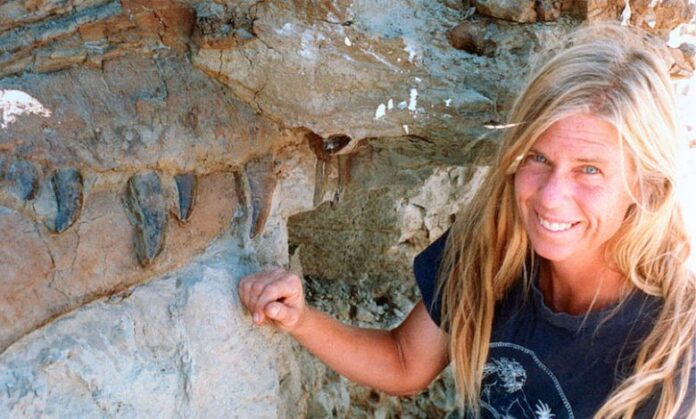


Sue Hendrickson is an American fossil hunter, field paleontologist, professional diver, and marine archaeologist. She is best known for discovering the Tyrannosaurus rex specimen now called SUE during a fossil expedition in South Dakota in 1990.
The discovery brought Hendrickson international recognition, but it represents only one part of a broader career. She has worked as a professional diver since the early 1970s, participated in underwater archaeological expeditions, collected fossils preserved in amber, and contributed to field projects in several countries.
Hendrickson followed an unconventional professional path shaped by practical experience rather than a traditional university science career. Her work demonstrates the importance of observation, persistence, technical field skills, and collaboration in scientific discovery.
Featured Snippet: Who Is Sue Hendrickson?
Sue Hendrickson is an American fossil hunter, field paleontologist, professional diver, and marine archaeologist. She discovered SUE, one of the most complete Tyrannosaurus rex skeletons ever found, near Faith, South Dakota, on August 12, 1990. The fossil was named in her honor and is displayed at Chicago’s Field Museum. [1]
Commonly Searched Questions About Sue Hendrickson
What did Sue Hendrickson discover?
Sue Hendrickson discovered several large fossilized vertebrae protruding from an eroded bluff in South Dakota in 1990. The bones belonged to a remarkably complete Tyrannosaurus rex. The specimen, officially catalogued as FMNH PR 2081, became known as SUE in recognition of its discoverer. [1]
How did Sue Hendrickson find SUE the T. rex?
Hendrickson found the fossil while participating in a commercial expedition north of Faith, South Dakota. After noticing vertebrae exposed in a bluff, she suspected that more of the skeleton remained underground. A six-person team then spent 17 days excavating the bones. [1]
Where is SUE the T. rex now?
SUE is permanently housed at the Field Museum in Chicago. The museum purchased the specimen at auction in 1997 and publicly unveiled the prepared skeleton in 2000. It is displayed in a dedicated gallery within the museum’s Griffin Halls of Evolving Planet. [1]
Is Sue Hendrickson a trained paleontologist?
Hendrickson is professionally described as a field paleontologist and fossil specialist, but her expertise developed mainly through practical work rather than a conventional academic degree program. Her experience includes fossil excavation, amber research, professional diving, marine archaeology, and museum consulting. [2]
Why is SUE scientifically important?
SUE is approximately 90 percent complete and includes about 250 of the roughly 380 bones known in a Tyrannosaurus rex skeleton. Its preservation has supported research into the animal’s anatomy, growth, injuries, movement, and life history. [1]
Sue Hendrickson Profile Summary
| Field | Information |
|---|---|
| Full name | Susan Hendrickson |
| Common name | Sue Hendrickson |
| Birth year | 1949 |
| Birthplace | Chicago, Illinois, United States |
| Childhood hometown | Munster, Indiana |
| Nationality | American |
| Occupations | Fossil hunter, field paleontologist, marine archaeologist, professional diver |
| Best known for | Discovering SUE the T. rex |
| Discovery date | August 12, 1990 |
| Discovery location | North of Faith, South Dakota |
| Fossil specimen number | FMNH PR 2081 |
| Associated museum | Field Museum, Chicago |
| Professional archaeology association | Franck Goddio’s underwater archaeology team |
| Diving career | Professional diver since 1971 |
| Published book | Hunt for the Past: My Life as an Explorer |
| Honorary degree | Doctor of Humane Letters, University of Illinois Chicago |
| Major documented honor | WINGS WorldQuest Women of Discovery Award, 2005 |
| Formal university degree | Not publicly confirmed |
Early Life and Background
A post shared by Prehistoric Dinosaur Hub (@prehistoric.dinosaur.hub)
Sue Hendrickson was born in Chicago in 1949 and grew up in Munster, Indiana. Accounts of her childhood describe a strong interest in reading, collecting unusual objects, and exploring her surroundings.
She did not initially follow a conventional academic or professional route. After leaving Indiana, she became involved in diving and field-based work. Her early career included collecting tropical fish, diving for lobsters, recovering material from modern wrecks, and searching for shells.
These activities helped her develop abilities that later became important in archaeology and paleontology. Both disciplines require patience, close visual observation, physical endurance, and careful treatment of fragile material.
Hendrickson’s career is sometimes presented as a sudden success story built around a single dinosaur discovery. In reality, she had years of diving, collecting, excavation, and fossil-hunting experience before finding SUE.
Education
Reliable institutional sources do not document a completed university degree in marine biology or paleontology.
Some secondary biographies state that Hendrickson studied marine biology at the University of Washington. Other accounts indicate that she considered university study but continued working as a diver instead. Without a clear university record, it is safer not to describe her as a University of Washington graduate.
Her professional education was largely practical. She learned through diving expeditions, fossil digs, underwater surveys, salvage operations, amber collecting, museum work, and collaboration with scientists and archaeologists.
In 2000, the University of Illinois Chicago awarded Hendrickson an honorary Doctor of Humane Letters. This recognition was honorary and should not be confused with an earned research doctorate or science degree. [3]
Career and Professional Journey
Professional Diving
Hendrickson began working as a professional diver in 1971. Her early assignments included collecting tropical fish for aquariums, diving for lobsters, gathering shells, and participating in modern salvage work.
Professional diving gave her experience in environments where visibility, time, physical movement, and access can be limited. It also taught her to identify objects that might be partly hidden by sediment, marine growth, rock, or debris.
These skills later transferred naturally to fossil hunting and underwater archaeology.
Fossils and Amber
Hendrickson became involved in paleontological fieldwork through expeditions and seasonal fossil digs. Her work extended beyond dinosaurs and included fossil whales, marine animals, and insects preserved in amber.
She developed particular expertise in fossil inclusions from amber deposits in the Dominican Republic and Chiapas, Mexico. In this work, the surrounding material can be as important as the visible specimen because it provides evidence about ancient ecosystems.
Her practical knowledge eventually led to work as a museum consultant and paleontological field specialist.
Also Read: John Cardiel Biography: Career, Accident, Recovery, and Legacy
Work with the Black Hills Institute
Before discovering SUE, Hendrickson participated in fossil expeditions connected with the Black Hills Institute of Geological Research. The organization conducted commercial paleontological work in the western United States.
During the summer of 1990, Hendrickson joined a team searching for dinosaur fossils in South Dakota. The expedition had already produced finds and was nearing its conclusion when she examined an exposed bluff that had not been fully explored.
That decision led to the most famous discovery of her career.
Discovery of SUE
On August 12, 1990, Hendrickson noticed several large vertebrae protruding from rock north of Faith, South Dakota. She followed the exposed material and concluded that additional bones might remain beneath the surface.
A team of six people spent 17 days excavating the specimen. The recovered skeleton was unusually complete and well preserved. It eventually became known as SUE, although its official museum identification is FMNH PR 2081.
The name honors Sue Hendrickson. It does not indicate the dinosaur’s biological sex, which remains unknown.
Ownership Dispute and Museum Acquisition
The excavation was followed by a prolonged legal dispute involving ownership and custody of the fossil. Hendrickson was the discoverer, but discovery did not make her the legal owner of the skeleton.
After the dispute was resolved, SUE was offered at public auction in 1997. The Field Museum acquired the specimen for $8.4 million with financial support from corporate and private partners. At the time, it was the highest price paid for a fossil at auction.
Museum staff then spent tens of thousands of hours preparing the bones and constructing the exhibit. SUE was publicly unveiled in May 2000 and later moved to a dedicated gallery.
Marine Archaeology
Hendrickson’s work continued well beyond the discovery of SUE. She joined underwater archaeologist Franck Goddio’s team in the early 1990s and has been associated with its projects for decades.
Her responsibilities have included professional diving, archaeological fieldwork, object recovery, survey assistance, and coordination. She also served as a foreign liaison for CariSub, Cuba’s maritime archaeology department. [2]
Her expeditions have taken her to locations including Egypt, the Philippines, Cuba, Honduras, the Dominican Republic, Peru, and the Bahamas. WINGS WorldQuest identifies shipwrecks and submerged ancient settlements among the major sites connected with her career. [4]
The range of her work is significant. It shows that Hendrickson is not solely a dinosaur specialist but an interdisciplinary explorer whose career includes paleontology, archaeology, diving, natural history, and museum research.
Also Read: Emily Rosenfeld Biography: Andy Cohen’s Sister and Career
Major Achievements and Recognition
Discovery of a Major T. rex Specimen
Hendrickson’s most important public achievement remains the discovery of SUE. The skeleton measures more than 40 feet in length and stands approximately 13 feet tall at the hip.
The Field Museum reports that about 90 percent of the skeleton was recovered, including 250 known bones. Its completeness has allowed researchers to examine features that are missing or poorly preserved in many other Tyrannosaurus rex specimens.
Although SUE is often called the largest T. rex ever found, newer comparisons have led researchers to debate which specimen was largest by mass. It is more accurate to describe SUE as one of the largest and among the most complete and best-preserved T. rex skeletons known.
Honorary Degree
The University of Illinois Chicago awarded Hendrickson an honorary Doctor of Humane Letters in 2000. The degree recognized the wider importance of her discoveries and exploration career. [3]
WINGS WorldQuest Recognition
In 2005, Hendrickson received a WINGS WorldQuest Women of Discovery Award for her commitment to exploration. The organization recognizes women whose fieldwork expands knowledge of the natural and cultural world. [4]
Some secondary biographies also claim that she received special recognition at the 2005 Glamour Women of the Year Awards. However, this claim is not clearly supported by Glamour’s own published history of its 2005 honorees. The documented WINGS award should not be confused with a Glamour award.
Published Work
Hendrickson published Hunt for the Past: My Life as an Explorer in 2001. The autobiographical book introduced younger readers to her work in diving, fossils, shipwrecks, and archaeology.
Her career has also been presented in museum exhibitions, documentaries, educational publications, interviews, and children’s books about scientific discovery.
Personal Life
Hendrickson has kept much of her private life outside public view.
She was born in Chicago and raised in Munster, Indiana. Some secondary biographical sources identify siblings named John and Karen, but detailed information about her family is not consistently documented by primary institutional sources.
Reliable public records do not provide a complete account of her relationships, marital history, or children. These subjects should not be expanded through speculation or information copied from unverified biography websites.
Hendrickson has spent extended periods living and working outside the continental United States. WINGS WorldQuest has reported that she established an animal-care clinic on Guanaja, an island in Honduras, where she has cared for dogs and other animals. [5]
Philanthropy and Public Engagement
No widely documented evidence shows that Hendrickson operates a large charitable foundation or formal international nonprofit organization.
Her most clearly documented community activity involves animal welfare. WINGS WorldQuest reported that she created a veterinary clinic that cared for dogs, cats, horses, pigs, parrots, and other animals. She also helped arrange adoptions for dogs. [5]
Hendrickson has contributed to public science education through interviews, museum appearances, books, and programs for young readers. Her public message has generally emphasized curiosity and persistence rather than formal credentials alone.
Her association with SUE has also helped museums explain how fossils are located, excavated, prepared, researched, and displayed.
Public Perception and Misconceptions
Misconception: SUE Was a Female Dinosaur
The dinosaur’s biological sex has not been established. The skeleton is called SUE because it was named after Sue Hendrickson, not because researchers determined that the animal was female. [1]
Misconception: Hendrickson Found and Excavated SUE Alone
Hendrickson made the initial discovery by identifying exposed vertebrae and recognizing their importance. The full excavation was a team effort involving six people over 17 days.
Credit for finding the fossil belongs to Hendrickson, while its recovery, preparation, study, and display involved many additional specialists.
Misconception: She Owned the Skeleton
Finding the fossil did not give Hendrickson permanent ownership. The specimen became the subject of a legal dispute and was eventually returned to the landowner before being sold at auction.
Misconception: She Is Only a Dinosaur Paleontologist
Hendrickson’s work includes professional diving, marine archaeology, salvage, amber fossils, shipwrecks, submerged settlements, museum consulting, and animal welfare.
The discovery of SUE made her famous, but it does not represent the full scope of her career.
Misconception: She Earned a Marine Biology Degree
A completed marine biology degree is not confirmed by reliable institutional documentation. Her verified academic recognition is an honorary Doctor of Humane Letters awarded by the University of Illinois Chicago in 2000.
Public Perception
Hendrickson is often presented as an example of an independent explorer who built scientific expertise outside a standard academic career.
That description is broadly accurate, but it should not suggest that major fossil or archaeological work is performed without professional standards. Her success depended on years of technical experience and collaboration with excavation teams, museums, archaeologists, paleontologists, divers, and research organizations.
Also Read: Delaney Benson Biography: Age, Parents, Education, and Theatre Career
Privacy and Limited Public Information
Several details about Hendrickson’s life remain unavailable or supported mainly by secondary sources.
Her complete school record, family relationships, private residence, finances, and relationship history are not comprehensively documented by authoritative institutions. Net-worth estimates should therefore be excluded from reliable biographies.
Accounts of her education require particular caution. An honorary doctorate is not the same as an earned university qualification, and an interest in marine biology does not establish completion of a degree program.
Responsible profiles should rely primarily on museum records, university archives, professional archaeology organizations, published interviews, and Hendrickson’s own autobiographical work.
Legacy and Influence
Sue Hendrickson’s legacy is closely connected with one of the most significant dinosaur specimens in a major museum collection.
SUE has allowed paleontologists to study Tyrannosaurus rex anatomy in unusual detail. The specimen has also introduced millions of museum visitors to fossil preparation, dinosaur biology, and the scientific value of complete skeletons.
Hendrickson’s wider career shows how skills can transfer across different forms of exploration. The observation used to identify an unusual bone in rock is related to the attention required to locate an artifact underwater or an insect inside amber.
Her professional journey has particular educational value because it demonstrates that scientific fieldwork involves more than academic theory. Discovery also depends on technicians, divers, collectors, preparators, field assistants, local experts, and specialists who work in difficult environments.
Her career has encouraged interest in exploration among young readers and has increased the visibility of women working in field paleontology and marine archaeology. This influence can be documented through museum programming, educational books, exploration awards, and continued public interest in the story of SUE.
Frequently Asked Questions
When did Sue Hendrickson discover SUE?
Sue Hendrickson discovered the exposed bones on August 12, 1990. She was participating in a fossil expedition north of Faith, South Dakota, when she noticed vertebrae protruding from an eroded bluff.
How complete is SUE the T. rex?
The Field Museum describes SUE as approximately 90 percent complete. About 250 of the roughly 380 bones known in a T. rex skeleton were recovered, making it one of the most complete examples available for scientific research.
How much did the Field Museum pay for SUE?
The Field Museum acquired SUE at a public auction in 1997 for $8.4 million. The purchase received support from McDonald’s Corporation, Walt Disney World Resort, and private donors.
What other work has Sue Hendrickson done?
Hendrickson has worked as a professional diver, marine archaeologist, fossil collector, amber specialist, museum consultant, and archaeological fieldworker. She has participated in projects involving shipwrecks, submerged ancient settlements, fossil animals, and insects preserved in amber.
Did Sue Hendrickson attend university?
There is no reliable public confirmation that she completed a university degree. She received an honorary Doctor of Humane Letters from the University of Illinois Chicago in 2000, but an honorary degree is different from an earned academic qualification.
Conclusion
Sue Hendrickson is an American fossil hunter, marine archaeologist, professional diver, and field paleontologist whose career spans more than five decades.
Her discovery of SUE in South Dakota in 1990 led to the recovery of one of the most complete and best-preserved Tyrannosaurus rex skeletons known. The fossil is now a major research specimen and public exhibit at Chicago’s Field Museum.
Hendrickson’s work also includes underwater archaeology, amber fossils, shipwreck exploration, museum consulting, and animal welfare. Her record is best understood not as the story of one fortunate discovery but as the result of long-term field experience, careful observation, and interdisciplinary collaboration.